
Is a Home Lift the New Alternative to Single-Storey Living?
For many homeowners, there’s a simple assumption: if stairs become a problem, the next step is to move. Downsizing or switching to a bungalow is often seen as the natural path, even if it’s years away. It’s a decision that’s rarely questioned early on – but increasingly, other options are starting to enter the conversation.
Bungalows & Ground Floor Flats as the Go-to Option
In these spaces, everything is on one level, which usually removes the need to navigate stairs altogether. It’s easy to understand, widely accepted, and often recommended without much debate.
For many, it feels like the most straightforward way to maintain comfort and accessibility at home. There’s no need to adapt the property or introduce new features. Just a change of setting.

The Reality of Moving As You Age
Moving later in life is often seen as the most practical solution. In reality, it can be more complex.
There are the obvious costs to consider, such as estate agent fees, stamp duty, legal work, and the general expense of relocating. Beyond that, suitable properties are not always easy to find. Bungalows, in particular, can be limited in supply and often come at a premium.
There’s also the personal side. Leaving a familiar home, neighbours, and a well-known area is not always an easy decision – and new properties may involve compromises, like less space, a different layout, or a location that doesn’t quite match what you had before.
For some, the move makes sense. For others, it raises a question:
Is leaving the home the only way to make it work long term?

A Shift in Thinking
Rather than planning to move, more people are choosing to stay and adapt their existing home instead. This ‘don’t move, improve’ mindset reflects a broader change amongst British homeowners.
Homes are being seen as long-term spaces that can evolve, rather than something to leave behind when needs change. With more options available, planning ahead has become part of the conversation earlier on, and in this context, features that support movement around the home are being considered sooner.
Where a Home Lift Fits In
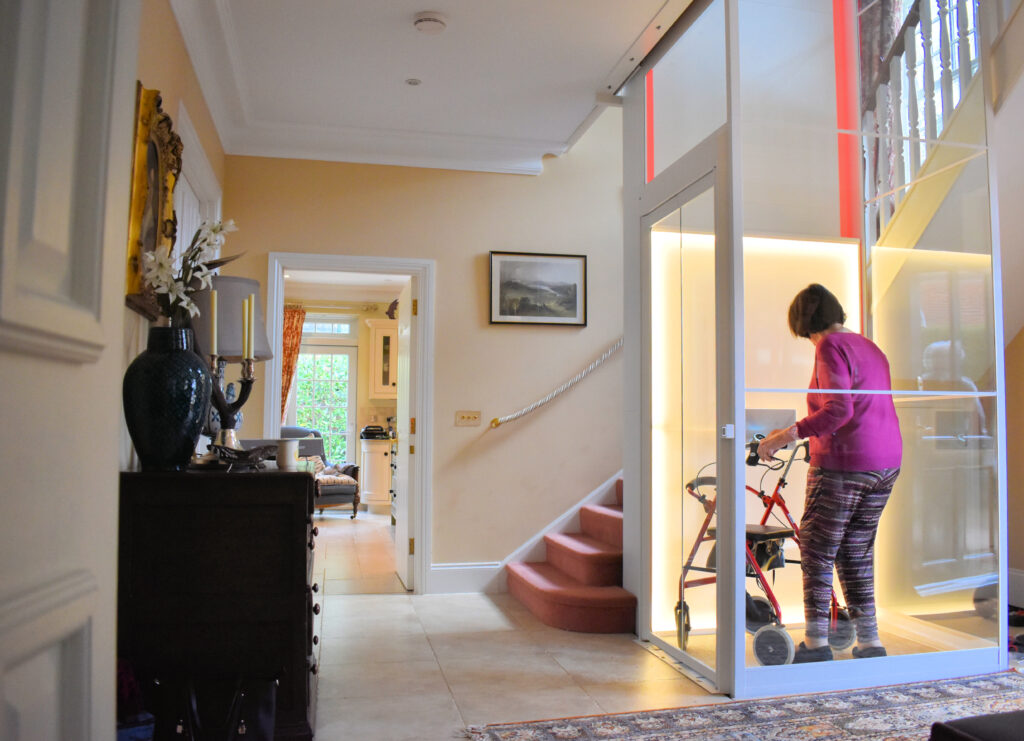
A home lift offers a different way to approach the same problem. Instead of changing the home to avoid stairs, it allows you to keep a multi-level layout while removing the reliance on them.
This means the structure of the home stays the same. Rooms remain where they are, routines don’t need to be reworked, and the overall feel of the space is unchanged. The difference is in how you move through it. Daily tasks become easier, and the full home remains usable without compromise.
It’s not the right option for every property or every situation. But as part of a wider shift towards adapting rather than relocating, it’s one more route worth considering – particularly when the goal is to stay in a home that already works in every other way.

Comparing the Two Paths
You have two options when stairs begin to feel less practical: move to a different property, or adapt the one you already have. We’ve broken down the choice visually to help you weigh up the pros and cons:
| Moving to a New Home | Adapting Your Current Home |
| A completely new environment | Staying in a familiar setting |
| Single-level living from the outset | Retaining a multi-level layout |
| A clean start with a different property | Keeping the home you already know |
| No need to modify the structure | Adding functionality where needed |
| May involve compromises on location or space | Maintains your current location and layout |
| A clear break from your existing home | Continuity in how you live day to day |
As you’ll see, neither route is inherently better – it depends on your priorities. One offers simplicity through change, the other through continuity.

When a Home Lift Makes Sense (and When It Might Not)
A home lift tends to make the most sense in properties where multiple floors are central to how the home is used. If you plan to stay long term, it can support that by keeping all areas accessible without changing the overall layout. Modern designs also mean space is less of a constraint than many expect, with options available that fit comfortably within smaller homes and existing layouts.
Where it may be less relevant is in short-term ownership, or where a move is already planned. In those cases, making changes to the current property may not be the priority. As with most decisions around the home, it comes down to how you live now, and how you expect that to evolve over time.
Broader Than Accessibility
Accessibility is often the starting point, but it’s not the whole picture. For many homeowners, the appeal is in how a lift fits into everyday life: making movement simpler, reducing effort, and removing small frictions that build up over time.
It becomes part of how the home works day to day. Carrying items, moving between rooms, and going about routines all become more straightforward, without needing to think about it.

Rethink What ‘Staying at Home’ Means
The traditional path isn’t the only one available. With more ways to adapt existing spaces, remaining where you are is becoming a practical option for many. Shaped around how you want to live, not just what’s expected.
Need More Answers?
Is it cheaper to install a lift or move house?
It depends on the property and the scope of work involved, but moving often comes with a range of costs. Installing a lift is a different type of investment, focused on adapting your current home. For many, it becomes a question of value rather than cost alone.
Can a lift be added to an older property?
Yes, in many cases it can. Modern home lifts are designed to work within existing structures, which makes retrofitting a realistic option for a wide range of homes. The exact approach will depend on layout and available space, but older properties are often just as suitable as newer ones.
Will a lift add value to my home?
A well-integrated lift can broaden the appeal of a property by making it more accessible and usable over time. While value depends on location and buyer demand, features that support long-term living are becoming more relevant to a wider range of homeowners and buyers.
Do lifts take up a lot of space?
Not necessarily. Most residential models are designed with a compact footprint and can fit within spaces similar to a small cupboard or wardrobe. Placement and design can be adapted to suit the layout of the home, especially when considered early.
Is a bungalow still the best option for accessibility?
For some, a single-storey home will always be the right choice. But it’s no longer the only option. Adapting a multi-level home can offer a way to maintain accessibility while keeping the space, layout, and location you already value.